
Post Content
Missing weights part 1: Study design and availability
Some folks have asked about expectations and approaches for weight missingness in Truveta Data. This post summarizes study design considerations and weight availability for our comparative effectiveness study. I’ll post about imputing missing weights next week.
Note that missingness was measured/addressed after cleaning up the weight values (more detail on that here).
Study design considerations
We made several study design choices that resulted in higher availability of weight data than if we had simply considered every adult in Truveta with a GLP-1 prescription or dispense. These include:
1. Requiring patients to receive usual care at a Truveta constituent health care system (HCS) (more on that here). Patients who regularly receive care in a Truveta HCS are likelier to return and have follow-up weight data.
2. Requiring a GLP-1 prescription within a Truveta HCS before the dispense. Truveta dispense data includes dispenses from outside Truveta HCS. Patients whose GLP-1 prescribing and related care occurred outside Truveta are less likely to have follow-up weights.
3. Requiring a weight measure at baseline. This was necessary to assess weight changes, but patients with previous weight measurements are also likelier to have future weight measurements.
4. Censoring patients at their last encounter or study end. In open EHR data, we have no information on what happened to patients after their last encounter, so we censor patients at their last encounter or study end, whichever occurred first. This means that all analyses are among the subset of people who are still coming back. Patients who started a GLP-1 and never returned – all of whom would be missing follow-up weight data - are not included because their index date (initiation) is the same as their censoring date (last encounter).
Follow-up weight availability
Before matching, 85% of study patients had at least one follow-up weight during observation (e.g., before censoring by last encounter or end of study), and 76% had at least one follow-up weight while on treatment. On average, patients had 5.8 follow-up weights per person-year observed (ITT) and 6.12 weights per person-year on treatment.
After matching, 84% patients had at least one follow-up weight during observation, and 75% had at least one follow-up weight while on treatment. There was an average of 5.4 follow-up weights per person-year observed (ITT) and 5.7 weights per person-year on treatment.
Analyses of percentage change in body weight at fixed time points only considered follow-up weights taken near the time points of interest, t (t ∈ 3,6,12 months). We used the value closest to t, with a 45-day window on either side. This means follow-up weights at t were unavailable for patients censored before t, and for those not yet censored but who lacked a follow-up value within 45 days of t.
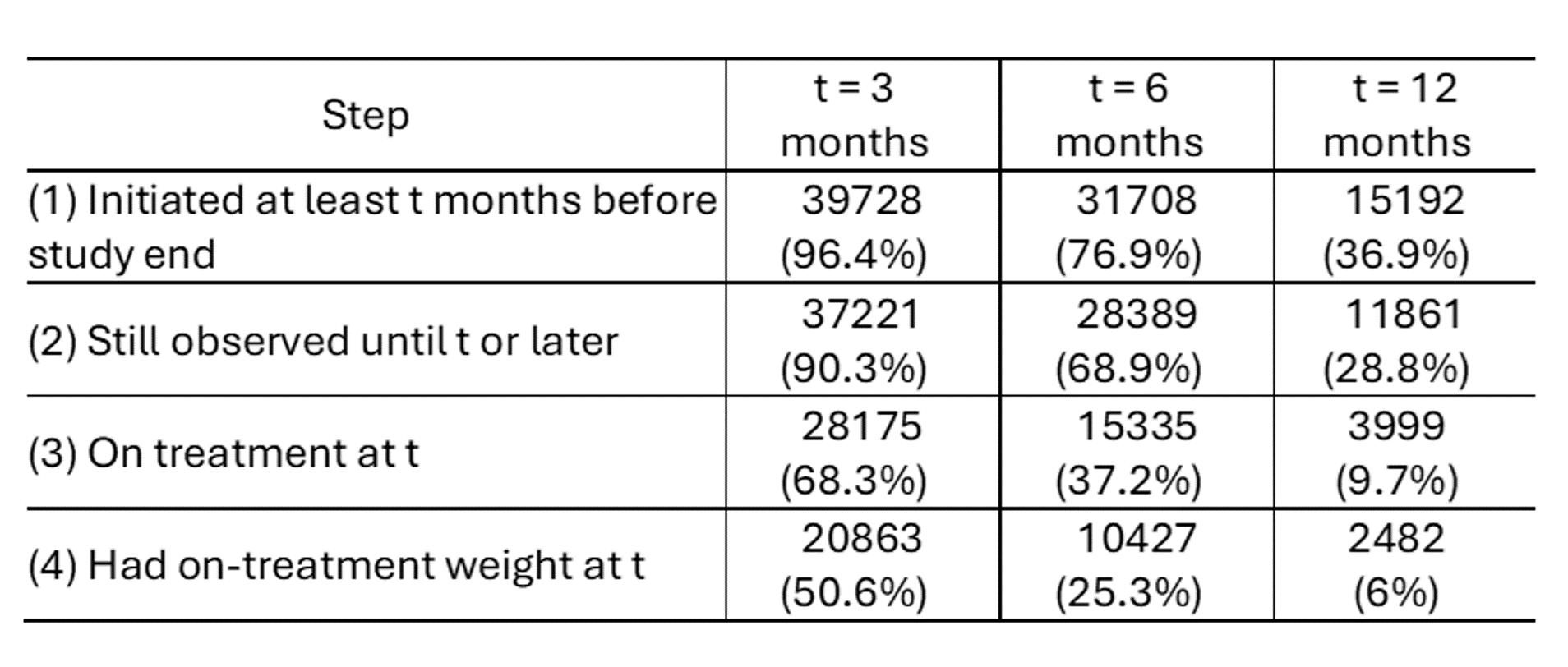
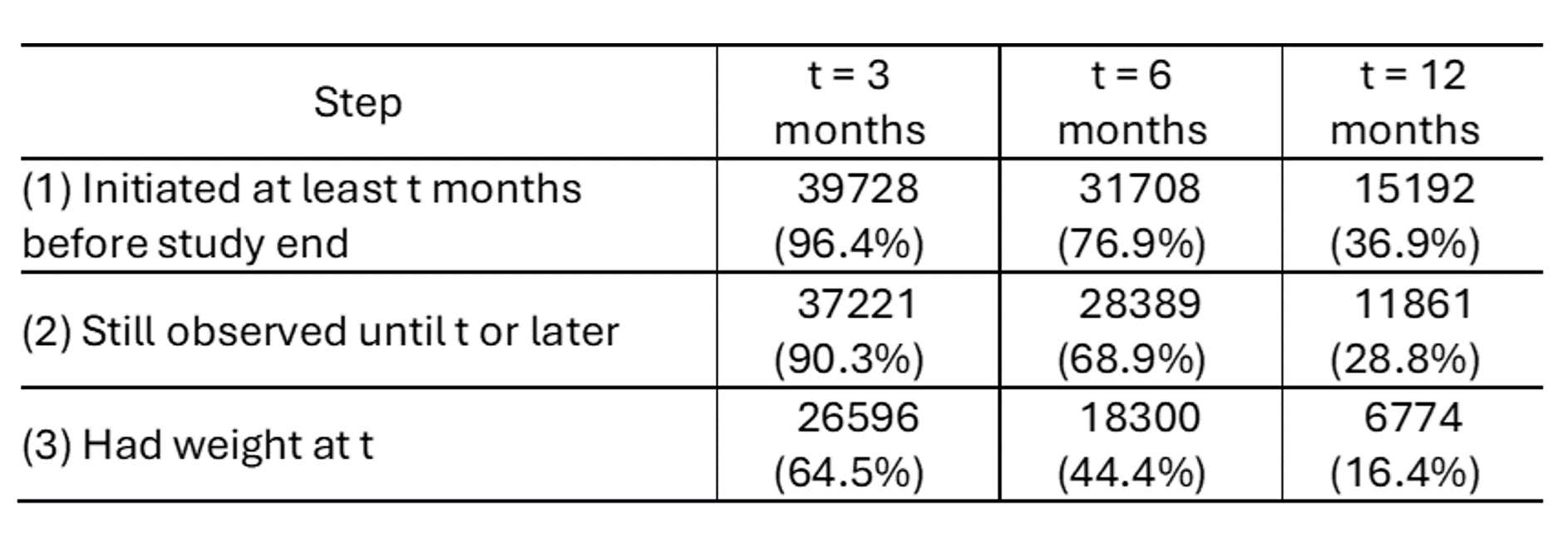
For all t, the majority of patients still on treatment (Table 1)/under observation (Table 2) had weight values at t. Table 1 shows the number and proportion of patients at each t who (1) were theoretically eligible for follow-up at t (initiated at least t months before study end), (2) were actually observed until t (last encounter ≥ t), (3) were still on treatment by t, and (4) had a weight value available in the 45 days before or after t.
Table 2 provides similar information for ITT analyses: the number and proportion of patients at each t who (1) were theoretically eligible for follow-up at t, (2) were actually observed until t (last encounter ≥ t), and (3) had a weight value available in the 45 days before or after t, regardless of treatment status at t.
Table 1: Weight Availability at t: On-Treatment Analyses
 Table 2: Weight Availability at t: ITT Analyses

Manually added:
Updated 6 months ago